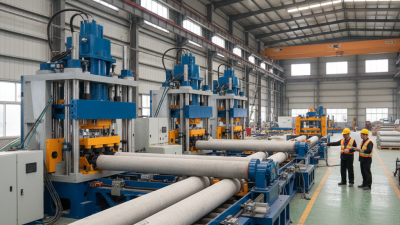
Distribution Networks
Urban, rural and industrial overhead power lines |
Prestressed spun or vibrated concrete poles; commonly approximately 8–15 m long, with tapered circular or polygonal sections |
Design for conductor loads, wind pressure, equipment weight, foundation conditions and local electrical clearances |
Rigid steel mould, accurate taper control, smooth internal surface and interchangeable openings for fittings |
Pole length, top and base dimensions, service load, ultimate load, cable arrangement and required embedment depth |
Transmission and Sub-Transmission
Higher-voltage overhead line structures |
Longer reinforced or prestressed poles, often used singly, in pairs or as multi-pole structures |
Higher bending capacity, controlled deflection, increased wind and ice-load resistance where applicable, and strict dimensional tolerances |
Heavy-duty mould body, reinforced end plates, accurate alignment system and repeatable prestressing or reinforcement positioning |
Structural loading case, pole slenderness, connection locations, cross-arm geometry and transport limitations |
Street Lighting
Roads, bridges, public areas and parking facilities |
Tapered concrete poles, typically about 6–12 m long, with a top fitting or luminaire mounting point |
Controlled verticality, resistance to wind-driven luminaire loads, cable access and compatibility with lighting brackets |
Precision top insert positioning, removable access-forming components and smooth finish suitable for exposed installations |
Mounting height, luminaire mass and projected area, wind region, cable-entry position and foundation interface |
Telecommunication Networks
Fiber, wireless and combined utility corridors |
Small- to medium-section tapered poles, generally selected for communication cables, cabinets and antenna accessories |
Low vibration, adequate reserve capacity, safe climbing or maintenance provisions and compatibility with shared utility corridors |
Modular mould sections, accurate embedded-part locations and adaptable holes for brackets, ladders or cable hardware |
Cable quantity, equipment weight, antenna wind area, attachment elevations and clearance from other services |
Railway Electrification
Overhead contact systems and railway signaling |
Reinforced or prestressed concrete masts and portal members with carefully positioned mounting inserts |
Strict geometry, durable performance under vibration, electrical clearance control and resistance to weathering and contamination |
High-dimensional-accuracy mould, robust insert fixtures, stable closure system and repeatable section alignment |
Track geometry, contact-wire height, cantilever loads, dynamic effects, corrosion exposure and installation tolerances |
Coastal and Marine Infrastructure
Harbors, coastal utilities and waterfront lighting |
Dense reinforced or prestressed concrete poles with enhanced durability requirements |
Low permeability, adequate concrete cover, crack control and resistance to chloride exposure, humidity and strong winds |
Leak-resistant joints, smooth mould surfaces, accurate cover control and materials suitable for repeated outdoor production |
Exposure classification, chloride environment, concrete cover, water-cement ratio, curing method and design service life |
Wind and Cyclone Regions
Areas exposed to severe storms or tropical weather |
High-capacity tapered poles, often prestressed, with reinforced foundations and engineered connections |
Resistance to high wind moments, debris impact where specified, fatigue effects and serviceability deflection limits |
High-stiffness mould, secure locking system, precise reinforcement positioning and repeatable production tolerances |
Basic wind speed, terrain category, gust factor, equipment projected area, pole height and governing load combination |
Cold-Climate Projects
Snow, freeze-thaw and seasonal ground movement zones |
Reinforced or prestressed poles designed for combined wind, ice and low-temperature exposure |
Freeze-thaw durability, suitable air entrainment where required, crack control and foundations designed for frost conditions |
Consistent wall or section thickness, smooth demoulding surface and accurate reinforcement cover control |
Minimum temperature, ice accretion, freeze-thaw cycles, concrete durability class and frost depth |
High-Volume Standardized Production
National utility programs and repeat infrastructure packages |
A standardized family of poles with several lengths, load classes and fitting arrangements |
Consistent quality, short cycle times, low rework rate, traceability and compatibility with automated or semi-automated production |
Reusable modular moulds, quick-release clamps, replaceable wear parts and inspection points for dimensional control |
Annual quantity, mould utilization rate, changeover time, maintenance interval and allowable dimensional variation |
Export and Remote-Site Projects
Projects with difficult transport or limited local facilities |
Pole designs optimized for available transport equipment, local aggregates and site assembly conditions |
Container or truck loading limits, local material availability, simple maintenance and reliable quality under variable conditions |
Sectional mould design, corrosion-protected steel, replaceable components and easy inspection without specialized equipment |
Maximum shipping length, mould weight, local concrete materials, lifting points, storage conditions and installation method |